




Can a double piston rod cylinder be used in printing equipment?
 Nov 19, 2026|
If you’ve ever walked through a commercial printing facility, you’ve seen the seamless, high-speed motion that powers everything from paper feeding to color layering and press sheet stacking. For anyone involved in printing equipment design or maintenance, the choice of actuation components can make or break production efficiency, precision, and equipment uptime. A question I get regularly as a double piston rod cylinder supplier is this: Can a double piston rod cylinder actually work in printing equipment? The short answer is a resounding yes—when matched to the specific demands of printing workflows, these cylinders solve problems single-rod designs can’t. To understand why, let’s break down what printing equipment needs, how double piston rod cylinders fill those gaps, and the specific configurations that work best for the job.
First, let’s ground this in what makes printing’s actuation requirements unique. Unlike general factory automation, printing systems operate with three non-negotiable rules: they need extreme positional accuracy to align color plates correctly, consistent force to handle heavy paper stacks without wrinkling or misfeeds, and durability to run 24/7 for weeks at a time with minimal maintenance. Single-rod cylinders, which are the most common, have a design quirk that undermines these needs: the side with the rod is asymmetrically weighted and has less surface area for load distribution. That means when you’re moving a heavy press roller or lifting a pallet of raw paper, single-rod cylinders can twist, drift off-position, or wear out unevenly over time—common headaches for print technicians dealing with unplanned downtime. That’s where double piston rod cylinders step in.
Let’s start with the core design benefit that matters for printing: symmetry. A double piston rod cylinder has a rod extending from both ends of the piston, so the load on either side of the cylinder is perfectly balanced. For printing components that require reciprocal motion—like the repeat feeding of paper into the press or the side-to-side movement of color drums—this symmetry eliminates the twisting that plagues single-rod setups. For example, in flexographic printing, where continuous, side-to-side anilox roll movement transfers ink to the plate, even a tiny amount of drift can cause uneven color layering, leading to wasted batches of print material. A double piston rod cylinder keeps that anilox roll aligned within 0.1mm of its target position, a precision that single-rod cylinders can’t reliably maintain after 1,000+ cycles.

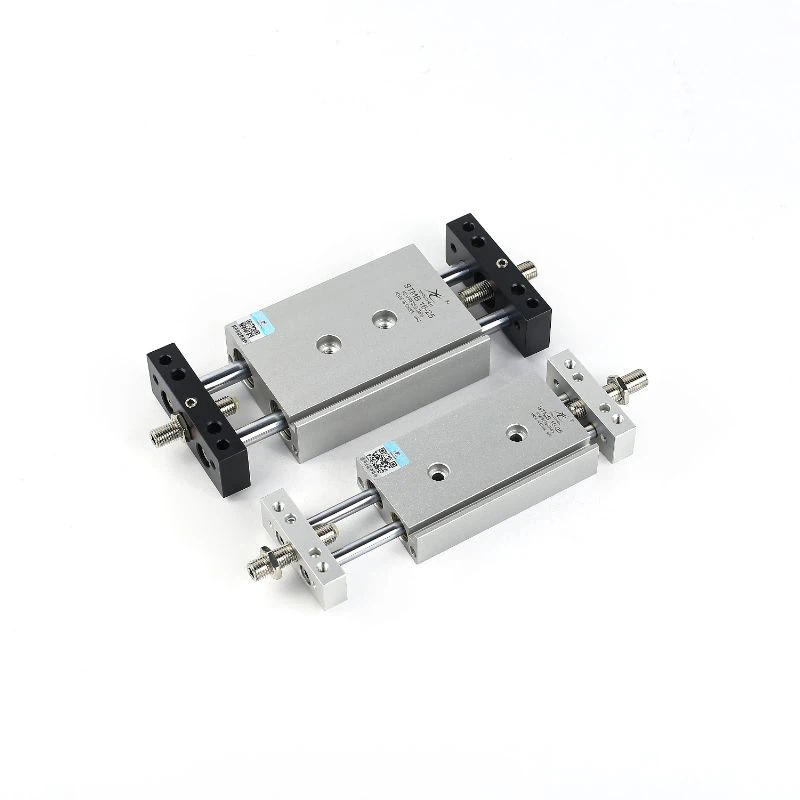
Of course, not all double piston rod cylinders are created equal. Printing equipment has a range of actuation needs, from small, fast movements for label printers to heavy-duty lifting for wide-format roll feeders. That’s why specific variants of dual-rod designs are tailored for these use cases. One of the most popular options in my catalog is the dual rod guided air cylinder—this model adds linear bearings along the rod paths, which is critical for high-speed printing where vibration and side loads are constant. In web offset presses, which run at speeds up to 1,500 feet per minute, the guided design prevents the rod from bending under the constant pull of the paper web, even during sudden speed adjustments. You can learn more about this specific configuration on our product page for dual rod guided air cylinder.
Another key variant for printing equipment is the double rod type dual rod cylinder, which features equal-length rods on both ends and is ideal for applications where the load is centered on the cylinder’s midpoint. For example, the cross-cut mechanism in sheet-fed presses, which slices continuous paper into individual sheets, requires the cutting blade to move back and forth at consistent speed. The double rod design ensures the blade stays parallel to the cutting bar, avoiding uneven cuts that would render entire sheets unusable. This variant also has a symmetric load capacity, so it can handle heavier cutting blades without deforming over time—a big upgrade from single-rod cylinders that often bend under the same load.
For applications that need both speed and force, like lifting full paper stacks onto the press feed, dual rod pneumatic cylinders are a go-to choice. Pneumatic systems are standard in printing because they’re low-cost, easy to maintain, and provide consistent force for lifting. The dual rod design here ensures that when you’re lifting a 500-pound stack of 100-pound cardstock, the force is distributed evenly, so the stack doesn’t tilt or shift during movement. That’s a huge safety benefit for print operators, and it also prevents misfeeds that happen if the stack is off-center. You can explore this line on our page for dual rod pneumatic cylinder.
Of course, some printing applications require even more specialized performance, which is why our line includes double acting double rod cylinders. Unlike single-acting cylinders that only extend in one direction, double acting designs can pressurize both ends, allowing for precise control of speed, position, and force in both push and pull motions. That’s perfect for things like registering print plates, where you need to fine-tune the distance between the plate and the blanket cylinder with micro-adjustments. The double acting dual rod design lets you make those adjustments smoothly, without the jerky movement or drift that comes with single-rod alternatives. If you’re working on high-precision registration tasks, this is the variant to specify, and you can find more details on our page for double acting double rod cylinders.
Now, you might be wondering: why not just use a standard pneumatic cylinder for printing? The answer comes down to durability and total cost of ownership. Printing equipment runs 10–12 hours a day, 5 days a week, and components that wear out quickly add up to lost production time. Single-rod cylinders have an average lifespan of 3–5 years in print environments, while double piston rod cylinders often last 8–10 years because of their balanced design. They also require less maintenance: the symmetric wear means you don’t have to replace seals or bearings as frequently, which cuts down on downtime for print runs. That’s a big selling point for print shop managers, who know that every hour of downtime can cost thousands in wasted materials and delayed orders.
That said, there are a few key considerations when integrating double piston rod cylinders into printing equipment, to make sure you get the right fit. First, stroke length: printing applications often need short, precise strokes (like for plate adjustment) or long strokes (like for paper stack lifting), so you need to match the cylinder’s stroke to your specific component. Second, mounting style: some double rod cylinders are designed for front or rear mounting, while others have side mounting options for tight spaces in compact label printers. Third, environmental resistance: printing shops have exposure to ink, paper dust, and occasional cleaning chemicals, so specifying a cylinder with a stainless steel rod and sealed bearings will prevent contamination and extend lifespan. All of these options are available in our full line of double piston rod cylinders, which you can browse on our product page for double piston rod cylinders.
I’ve seen too many print projects over the years where teams tried to cut costs with single-rod cylinders, only to end up with misaligned prints, broken components, and costly downtime. For example, a small commercial print shop in Ohio came to me last year after switching to a new single-rod cylinder for their poster press’s cross-cut mechanism. Within two months, the rods were twisting, causing uneven cuts that wasted $2,000 worth of paper each week. By switching to our double rod type dual rod cylinder, they cut that waste to under $200 a week and reduced maintenance time by 70%. That’s the kind of tangible benefit that makes double piston rod cylinders worth the initial investment.
Another example: a large web press manufacturer was struggling with the anilox roll movement on their new packaging press. The single-rod cylinders they were using would drift by 0.2mm during high-speed runs, leading to faded or inconsistent colors on food packaging labels, which is a major quality issue. We worked with their engineering team to specify our dual rod guided air cylinder, which eliminated the drift and brought color consistency within 0.05mm—meeting the exact standards required for food packaging. That press now runs 24/7 for 6 weeks at a time, with zero issues with the actuation components.
So, to circle back to the original question: Can a double piston rod cylinder be used in printing equipment? Absolutely. But it’s not a one-size-fits-all solution. The key is choosing the right variant for your specific application: use a guided dual rod cylinder for high-speed side-to-side movement, a double rod type for central load applications, a dual rod pneumatic cylinder for heavy lifting tasks, and a double acting double rod cylinder for precise bi-directional adjustments. All of these options are engineered to meet the unique demands of printing, delivering the precision, durability, and reliability that print operations need.
If you’re a printing equipment designer, maintenance technician, or shop owner looking to upgrade your actuation components and reduce downtime, we can help you find the right double piston rod cylinder for your needs. Reach out to our team to discuss your specific applications, from label printers to wide-format packaging presses, and we’ll walk you through the best configuration for your workflow.
References
- Society of Manufacturing Engineers. (2021). Actuation Systems for Precision Manufacturing in Printing. SME Press.
- Pneumatic and Hydraulic Institute. (2022). Dual Rod Cylinder Design and Application Guide. PHI Technical Bulletin 412.
- International Organization for Standardization. (2019). ISO 15552: Pneumatic fluid power—Cylinders—Mounting dimensions. ISO Standards.
- Printing Industries of America. (2020). Reducing Downtime in Print Operations: Component Selection Best Practices. PIA Technical Report.